Budget Prepper Rotation Systems: Stop Rebuying What You Already Own
Budget prepper rotation systems are one of the most overlooked cost-control tools in preparedness. Many households technically “have supplies,” yet still find themselves rebuying food, batteries, and essentials they already purchased months or years ago.
This isn’t a storage problem. It’s a flow problem.
Without a rotation system, supplies quietly age out, expire, or get forgotten, turning preparedness into a recurring expense instead of a stabilizing buffer.
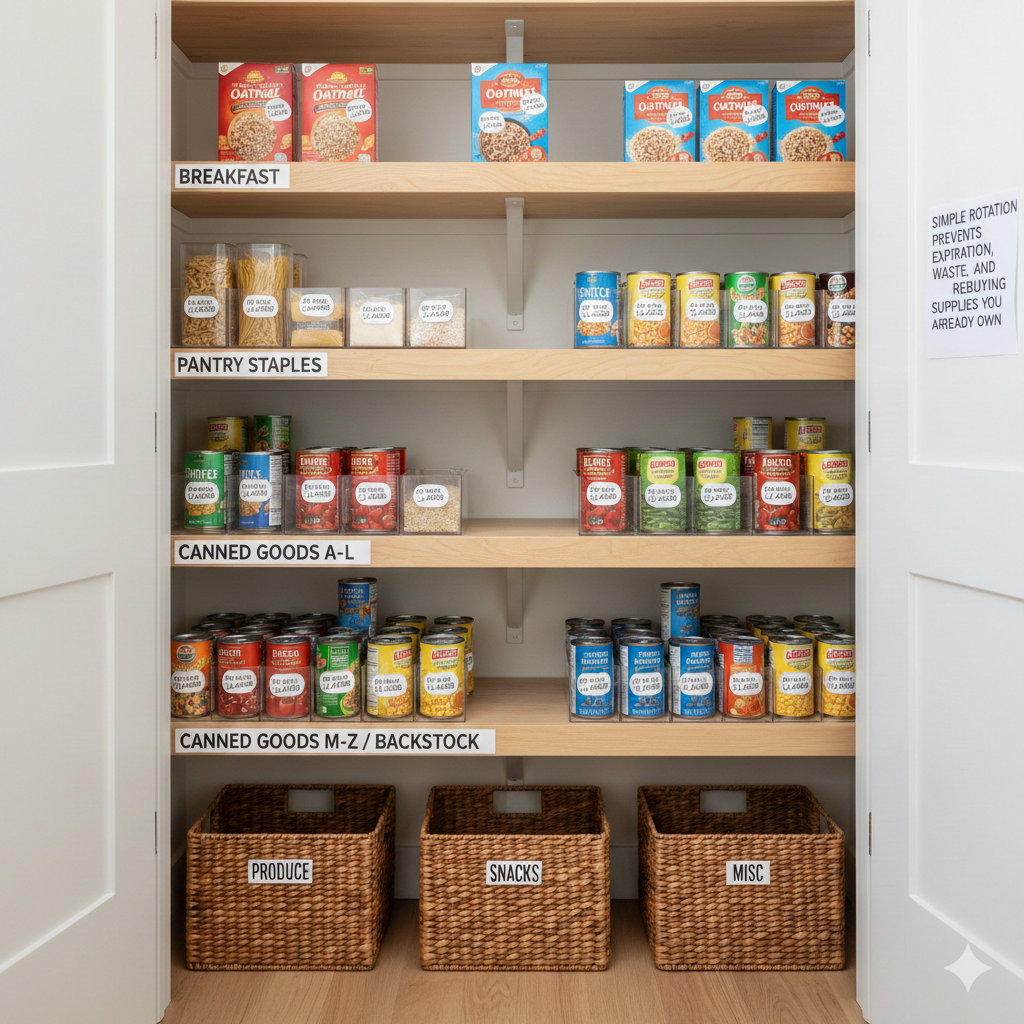
Why Storage Alone Fails Without Rotation
Most budget preppers focus on acquisition: buying deals, building a stockpile, and filling shelves. What’s missing is movement.
When items enter storage but never cycle back into daily use, three quiet failures occur:
- Expiration creep — food and consumables pass their usable window unnoticed
- False scarcity — you assume you’re out of something because you can’t see it
- Replacement shock — expired items must be replaced all at once, stressing the budget
This is why rotation matters more than volume. A smaller, rotating supply consistently outperforms a larger, static one.
The Flow-Based Rotation Framework (Core System)
A flow-based system treats preparedness supplies as part of household consumption, not emergency-only assets.
The framework has three rules:
- Everything enters at the back
- Everything exits through daily use
- Nothing lives in “special storage” indefinitely
This mirrors how professional food services and emergency management agencies manage perishables, including guidance reinforced by federal readiness standards at Ready.gov.
When supplies move, waste drops.
When supplies stagnate, money leaks.
Where Budget Prepper Rotation Systems Break Down
Even organized households fail at rotation for predictable reasons.
The “Emergency-Only” Assumption
Items labeled mentally as “for later” rarely get touched. Over time, they become invisible. This failure mode explains why people discover expired food during an emergency instead of before one.
The Bulk Buy Trap
Buying in bulk without mapping usage rate causes imbalance. If you consume one can per month but buy a year’s worth annually, rotation must be intentional—or half of it expires.
Category Isolation
Separating “pantry food” from “prep food” doubles inventory mentally. You buy twice, use once, and waste the rest.
University Extension Services regularly highlight that integrated household food systems reduce spoilage and cost, reinforcing why separation is expensive over time.
How Rotation Reduces Replacement Costs
Rotation smooths spending.
Instead of replacing an entire category at once, you replace incrementally, aligning purchases with normal grocery cycles. This protects the household budget during inflation spikes or supply disruptions, a concern also addressed in federal consumer preparedness guidance at Consumer.gov.
More importantly, rotation preserves optionality. When prices rise, you can pause buying instead of being forced into high-cost replacements.
Why This Fails Without a System
Rotation fails when it relies on memory.
A system succeeds because it removes decision-making:
- Items are dated when stored
- Shelves are organized for visibility
- Consumption is automatic, not intentional
Without this structure, even disciplined households regress over time. Preparedness becomes clutter, then stress, then abandonment.
This is why rotation should be treated as an optimization layer—not a beginner tactic.
Connecting Rotation to Broader Budget Prepping
Rotation systems strengthen everything else in the Budget Prepping Hub because they stabilize ongoing costs. If you already practice maintenance discipline, as discussed in Budget Prepper Maintenance: 9 Quiet Mistakes Costing You Money, rotation is the next logical optimization step.
It also prevents gardening output from overwhelming storage capacity, a risk explored in 7 Reasons Storage Garden Integration Saves Budget Preppers Money.
Preparedness works best when systems reinforce each other instead of competing for space and attention.
A Practical Starting Point (Without Overhauls)
You do not need new containers or expensive organizers.
Start with:
- One shelf per category
- Clear date markings
- A rule that prep food is normal food
That single change converts sunk costs into working assets.
For readers new to the philosophy behind this site, the approach outlined on the About page explains why calm systems outperform reactive stockpiling. Legal and usage disclosures remain available on the Terms & Privacy pages.