7 Food Storage Drift Signals to Catch Before Supplies Fail
Maintaining food storage is not a one-time achievement. Even well-organized systems slowly change as habits fade, labels wear off, and storage conditions shift. A food storage drift audit helps households identify these quiet failures before they turn into wasted money or unsafe supplies. This type of review is especially important for families who already have food stored and want confidence that it will actually perform when needed.
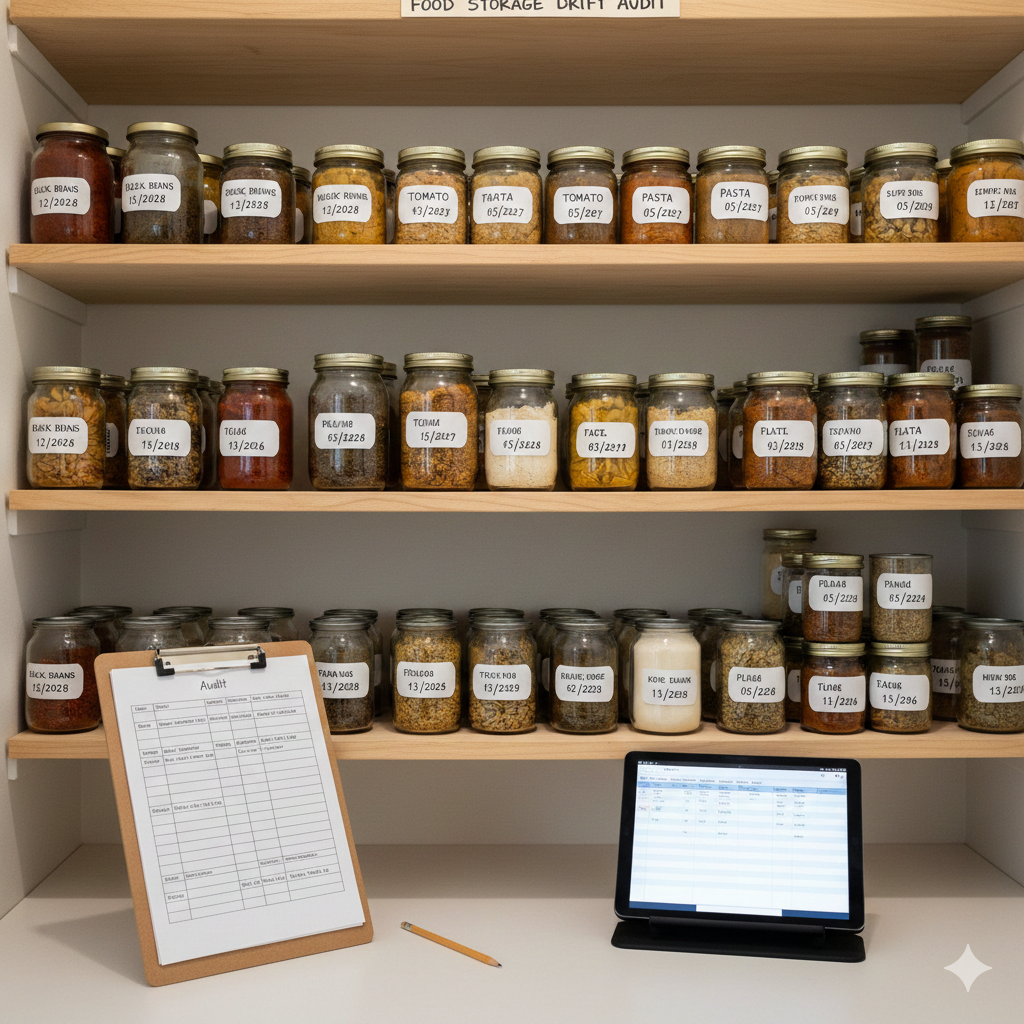
Why a Food Storage Drift Audit Matters
Most food storage failures are not dramatic. They develop quietly through small changes: a box pushed to the back, a label that fades, or a temperature shift no one notices. Over time, these changes reduce reliability. A food storage drift audit focuses on system health, not adding more food, aligning with the sustainability principles taught in the Budget Prepping Hub.
1. Food Storage Drift Audit: Label and Date Decay
Labels are often the first failure point. During your audit, look for:
- Faded or missing dates
- Illegible contents
- Containers without rotation notes
When labels degrade, rotation breaks down. The USDA’s food storage guidance emphasizes clear identification and dating to prevent accidental spoilage.
2. Container Integrity Drift Over Time
Even sturdy containers age. Inspect for:
- Hairline cracks
- Warped lids
- Broken seals
A food storage drift audit treats container wear as a predictable issue, not an emergency surprise.
3. Environmental Drift in Storage Locations
Garages, basements, and closets change with seasons. During your audit, verify:
- Temperature stability
- Absence of moisture
- Distance from chemicals or fuels
Ready.gov’s emergency food recommendations stress stable conditions as essential for long-term reliability.
4. Quantity Drift Away from Real Use
Stored amounts often no longer match actual household needs. Audit for:
- Foods no longer eaten
- Excess duplicates
- Items bought once but never rotated
This mirrors the practical budgeting mindset discussed in Food Storage on a Budget, where alignment matters more than volume.
5. Access and Visibility Drift
If you cannot easily see or reach stored food, rotation slows. During your audit:
- Move frequently used items forward
- Remove physical obstacles
- Simplify shelf layouts
University extension resources on home food storage consistently recommend visibility to reduce waste and forgotten items.
6. Habit Drift in Rotation Schedules
Even good systems fail when reminders stop. Check whether:
- Rotation intervals are still written down
- Reviews are tied to seasonal habits
- Responsibility is clearly assigned
A documented system prevents reliance on memory alone.
How Often to Run a Food Storage Drift Audit
A food storage drift audit does not need to be frequent to be effective. For most households, a quarterly review is sufficient to catch slow system degradation without creating unnecessary workload. This timing naturally aligns with seasonal changes that affect temperature, humidity, and household routines.
If your storage includes multiple locations—such as a pantry, basement, or garage—it may be helpful to stagger audits so each area receives focused attention rather than rushing through everything at once. Major life changes, such as moving, adding family members, or changing dietary needs, should also trigger an immediate audit regardless of schedule.
The goal is not perfection, but consistency. A food storage drift audit works best when it becomes a predictable maintenance habit rather than a reaction to visible problems. When reviews are planned and documented, small corrections stay small—and your system remains dependable.
7. Documentation Drift in Logs and Records
Logs quietly disappear over time. During your food storage drift audit:
- Confirm logs still exist
- Verify entries are current
- Replace damaged or missing records
Extension services frequently recommend written records because they reduce error and increase long-term consistency.
Stewardship Perspective
Scripture supports the idea that systems require faithfulness over time, not just good intentions.
reminds us:
“In this case, moreover, it is required of stewards that one be found trustworthy.” 1 Corinthians 4:2 (NASB)
A food storage drift audit is a practical expression of that stewardship—maintaining trust in what you already have.
Final Thoughts
Preparedness systems fail slowly, not suddenly. A food storage drift audit helps you identify small issues early, when they are inexpensive and easy to correct. By auditing labels, containers, environments, quantities, access, habits, and documentation, you strengthen reliability without buying more supplies.
For clarity on how this site approaches preparedness philosophy and values, see the About Page, and for site boundaries and data practices, review the Terms & Privacy Pages.